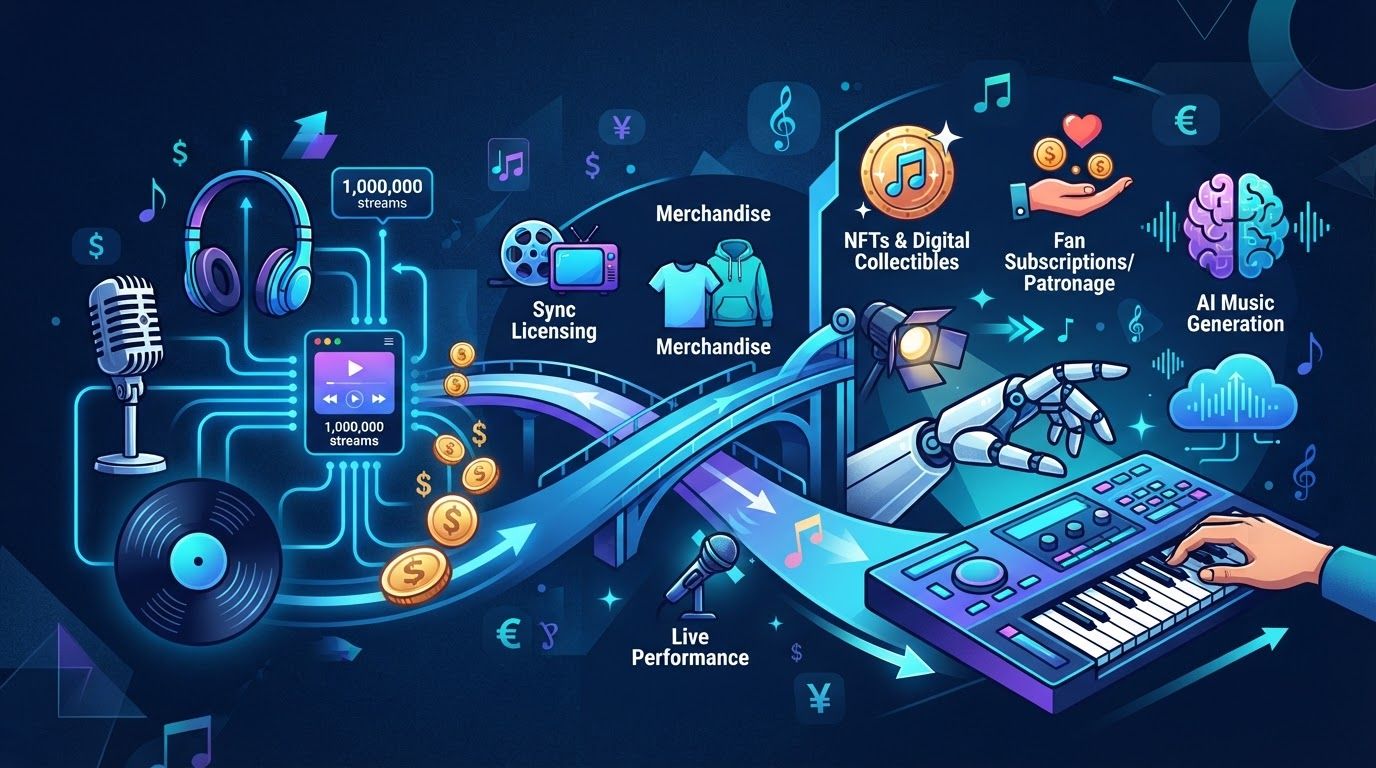
For independent artists, the best income paths for musicians are rarely a single platform or payout. Streaming remains the biggest recorded-music engine, but a more resilient career can also combine publishing, direct fan support, tickets, brand work, and carefully licensed AI collaborations.
The opportunity is real, but so is the work: each income source has different rights, partners, and ways to reach listeners. The practical goal is to build a connected system around your music, understand what each stream can and cannot do, and avoid treating industry-wide numbers as a personal earnings forecast.
Income paths for musicians: the short answer
Direct answer: Build a portfolio of income sources: distribute music for streaming royalties, register and track your songwriting rights, offer fans ways to support you directly, connect releases to tickets and experiences, pursue suitable brand or sync opportunities, and consider AI collaborations only when rights and compensation are clear.
Think of each release as both a listening experience and an asset that may serve different audiences over time. Streaming can help people discover and replay a recording; publishing can recognize the underlying composition; a ticket or fan offer can turn interest into a closer relationship. A licensed collaboration can create another use for the work, provided you control the rights needed to approve it.
There is a strong industry case for taking this wider view. IFPI reports that global recorded-music revenue reached US$31.7 billion in 2025, up 6.4%, with streaming accounting for 69.6% of the total and generating more than US$22 billion. That makes streaming essential to understand, not the only thing worth building.
Spotify also reported paying more than $11 billion to the music industry in 2025, with payouts growing more than 10% year over year. It said independent artists and labels accounted for half of all royalties on its service, and that more than a third of artists who generated at least $10,000 in Spotify royalties were DIY artists or began that way. These are platform-wide figures, not promises about what any one release will earn. They do show that self-releasing can be part of a serious career strategy.
Streaming royalties: build a release strategy, not a payout fantasy
Streaming is a useful foundation because it keeps recordings available where listeners already choose to hear music. It can support discovery, repeat listening, and a of work that remains accessible between live shows or other campaigns. But an individual artist’s results depend on their own audience and listening activity; global revenue totals cannot tell you what your next single will make.
Make the catalog easy to find and follow
Choose a release plan you can maintain. That might mean focusing on a carefully developed album, releasing singles that lead into a larger project, or building a regular schedule around the music you can finish well. A schedule is useful only if the songs, artwork, metadata, and promotion are ready. Releasing more often is not automatically better if it leaves listeners without a clear reason to connect with the work.
Before delivery, check artist name spelling, song titles, credits, release dates, and the ownership information requested by your distributor. Consistent details make it easier to recognize your catalog and reduce avoidable confusion. Keep your own records of the final audio, artwork, splits, and release information rather than relying on memory or a single platform dashboard.
- Give every release a next step. Point listeners toward another song, a mailing list, a show, or a fan offer that fits the moment.
- Use available audience signals. Notice which songs bring listeners back, which campaigns prompt meaningful responses, and where people discover the work. Treat those signals as clues, not a complete picture of your audience.
- Keep a longer view. A catalog can support future discovery and opportunities beyond the week of release. Maintain it carefully and make your best work easy to locate.
Spotify’s 2025 figures offer a reason to take streaming seriously without promising an outcome. The company said the 100,000th-highest-earning artist generated more than $7,300 in royalties from Spotify alone that year. It also reported that streaming payouts grew faster than other industry income sources, which it said grew closer to 4%. Those numbers describe one service and a broad market; they do not indicate a guaranteed threshold, a typical artist result, or a fixed value for each stream.
There is also a strategic limitation: the artist does not control when listeners press play or how a platform’s discovery systems reach them. Do not let a playlist placement or one release’s stream count become the whole plan. Use streaming as a durable access point, then give interested listeners other ways to stay connected.
Publishing royalties: track the song behind the recording
A recording and the composition embodied in it are related, but they are not the same asset. A recording is a particular performed and produced version; the composition is the underlying song, including its songwriting. Depending on the use and the applicable arrangements, income connected to a song may involve different rights and collection routes. That is why a release plan should include a publishing check, not just a distribution checklist.
Spotify said 2025 marked its largest annual music publishing payout in the service’s history. That is a platform-specific statement, not a claim that every songwriter will receive a particular amount. It does underline why songwriters should understand which rights they control and keep accurate information about contributors and ownership.
Make the paperwork part of the creative process
When a song is written with collaborators, agree on the songwriting shares and document them while everyone remembers the conversation. Confirm who wrote what, how the credits should appear, and who is responsible for submitting information to relevant services or representatives. If you have a publisher, administrator, or other partner, understand what it handles and what remains your responsibility.
Keep a simple song register with working and final titles, writers, agreed splits, contact details, release versions, and any relevant registrations. Update it when a song changes or an alternate version is released. A tidy record makes it easier to answer questions when a track is used in a new context or a collaborator needs to verify information.
- Check whether your writer and song information is complete and consistent across the places where you manage rights.
- Keep agreements and split confirmations in a durable, accessible location.
- Review statements and reports rather than assuming every use has been identified correctly.
- Ask a qualified music-rights professional about unclear ownership, conflicting claims, or unfamiliar contract language.
Do not confuse an increase in a platform’s publishing payments with a guarantee that your own registrations are complete. A platform payout can only be useful to your career if the relevant rights, ownership information, and payment arrangements are in order. If you write, produce, or perform in different roles, make sure your records reflect those roles rather than treating every contribution as the same kind of right.
Direct fan income: turn attention into a relationship
Streaming can introduce someone to a song, but direct fan monetization gives a listener a closer way to support the artist. The offer does not need to be complicated. It might be access to a ticket presale, a limited fan experience, a paid community, merchandise, or a special release. The key is to offer something that fits your work and that you can reliably deliver.
Spotify said in its 2026 Investor Day messaging that it is developing additional income sources for artists and songwriters through paid add-ons tied to fan demand and discovery. It also described tools around tickets and fan access, including premium experiences intended to help artists convert listeners into higher-value supporters. These developments point toward more platform-based options, but they do not remove the value of having a direct way to communicate with your audience.
Design an offer around what fans already value
Start with a question: what would a listener who already cares about this music genuinely want next? For one artist, it may be an intimate show. For another, it may be early access to a release, a behind-the-scenes session, or a physical item connected to a specific project. Avoid building a complicated membership or product before you know whether you can serve it consistently.
Make the terms clear. Explain what a fan receives, when they will receive it, how access works, and whether an offer is limited. Keep the process straightforward, and be realistic about the time and costs involved. A small, well-run offer can be more valuable to your career than a large promise that becomes difficult to fulfill.
- Choose a specific audience. Consider who is most engaged, not only how many people encountered a track.
- Offer one meaningful next step. Match the offer to a release, a live date, or a moment when fans are already paying attention.
- Explain the value and logistics. State exactly what is included and how supporters can take part.
- Review the response. Learn what people use and ask for before expanding the offer.
Direct support is not a replacement for broad reach, and not every listener will want a paid experience. Think of it as an additional layer for the people who already want a closer connection. A mix of free listening and optional paid support lets different fans engage at the level that suits them.
Tickets, brand partnerships, and sync: match the opportunity to the music
Live performance can connect recorded music to a shared experience and ticket income. The practical fit depends on your audience, location, setup, and ability to deliver a good event. Start with shows you can promote and perform well, then build from the response. Keep an eye on the full economics: a ticket price is not the same as profit after expenses, and a sold-out room is not the only measure of whether a show served your career.
Ticketing and fan access are increasingly part of platforms’ plans for artist monetization. Spotify has described work on tickets and premium fan experiences as ways to help artists move from listening toward higher-value support. Treat any platform feature as one possible route, not the entire ticketing strategy. Keep your own audience informed and make the path from music to event easy to understand.
Approach brand work with a clear fit test
A brand partnership may bring payment, access to an audience, or other agreed value, but it can also affect how fans understand your work. Before saying yes, check whether the partner’s product and campaign fit your identity, whether the deliverables are realistic, and what rights the agreement asks you to grant. Put the scope, term, payment, approval process, and permitted uses in writing.
Do not assume that a large brand name makes a deal worthwhile. Consider what you need to produce, how much time it will take away from other work, whether your music or image can be reused, and whether the audience is relevant. Ask for advice when the contract language is unclear, especially around exclusivity, ownership, or future use of recordings and compositions.
Use sync as a rights-and-context opportunity
Sync licensing involves permission to use music with visual media, such as a film, series, advertisement, or other production. For an independent musician, it is worth preparing a clear catalog and making sure you know who can approve both the recording and the composition. If collaborators own part of either, their approval may matter. Accurate splits and contact information are practical assets, not administrative clutter.
Consider whether a track is suitable for the intended scene and whether you are comfortable with the context. A brief should clarify the media, territory, duration, exclusivity, and permitted edits or versions. Do not accept vague promises in place of defined terms. If a request involves rights you do not control, tell the other party before an agreement is made.
Streaming, tickets, brand work, and sync serve different purposes. One can help people hear the catalog, another can create a live connection, and another can license a specific use. You do not have to pursue every route at once. Choose opportunities that fit your sound, current capacity, and rights position.
AI co-creation: pursue licensing, consent, and a fair share
AI is becoming part of the music business conversation in two ways: as a tool in creative workflows and as a potential user of music and creator data. Spotify has described the industry’s evolution as moving from access to personalization to generation, framing AI-assisted creation as part of the changing platform landscape. That does not mean every tool is suitable for every artist, or that using AI removes the need for human direction, skill, and judgment.
For musicians, the central income question is not simply whether AI can generate music. It is who controls the inputs, what permissions are granted, how a work is used, and whether creators share in the value. IFPI says record companies are working on music-licensing models for AI that could create revenue opportunities while supporting human artistry. IFPI has also argued against broad copyright exemptions for AI training, stating that there is no economic basis for weakening existing copyright protections.
“Human creativity is not the enemy of artificial intelligence,” Björn Ulvaeus said in CISAC-related coverage, reflecting a push to make licensing and revenue-sharing part of the discussion.
The practical stance can be both curious and careful. Experiment with tools where you understand the terms, and keep notes about what was generated, what you contributed, and what rights the service claims. Do not upload collaborators’ unreleased material or grant broad permissions on their behalf without agreement. If a tool’s terms are difficult to understand, pause before using it for work you plan to release commercially.
Questions to ask before an AI collaboration
- What is being licensed? Identify whether the agreement covers a recording, composition, voice, likeness, performance, training use, or something else.
- Is participation meaningful and voluntary? A 2026 creator statement argues that artists should not be pressured into AI deals without meaningful consent.
- How is creator compensation calculated? Ask what share of revenue goes to creators, how it is measured, and when it is paid.
- Can the work be identified and tracked? Clarify how uses, versions, and attribution will be handled.
- What happens after the deal ends? Understand whether permissions continue, whether material can remain in a system, and what rights you retain.
These are not abstract concerns. Music Business Worldwide reported in 2026 that CISAC’s global collections report put songwriter royalty collections at a record $15.9 billion in 2025, with AI in focus for future creator pay. That points to a live policy and business issue, not a settled royalty model. Until terms are clear, do not assume that an AI-related opportunity will automatically create a new income stream for the musicians whose work contributed to it.
Platform safeguards are also evolving. Spotify said it labels when an artist’s identity is believed to be AI-generated and described its 1,000-stream royalty threshold as a first-line defense against AI spam. Those measures do not answer every question about training, attribution, or fair compensation. They do show why artists should pay attention to identity, catalog integrity, and the policies of the services they use.
Build a practical income portfolio around your next release
A diversified plan does not require six separate campaigns or a team behind you. Start by choosing a release or catalog focus, then connect the income paths that make sense for that work. The sequence matters: accurate rights information supports licensing and publishing; a release can point to a live date; an engaged audience can inform a direct offer. Each step should make the next one easier rather than creating busywork.
A simple 90-day planning sequence
- Audit the rights. List the recordings and compositions you plan to use. Confirm collaborators, ownership information, agreed splits, and who can approve new uses.
- Prepare the release. Check titles, credits, artwork, delivery details, and the destination you want listeners to visit after hearing the music.
- Choose one audience action. Decide whether the release should lead to a show, a mailing list, a fan experience, or another clear next step.
- Make one additional offer. Consider whether a particular song fits a sync pitch, brand conversation, or licensed AI project. Pursue it only if the rights and terms are workable.
- Review what happened. Track the income received, costs, audience response, and tasks that took more time than expected. Use that review to choose the next experiment.
Keep a simple money and activity log. Record payments by source, related costs, dates, and any obligations attached to the income. Distinguish a confirmed payment from an estimate or a platform metric. This makes it easier to understand which activities support your career and to ask informed questions of distributors, publishers, platforms, or professional advisers.
Build your portfolio at a pace you can sustain. A songwriter with a growing catalog may prioritize rights administration and licensing readiness; an artist with a local audience may focus on reliable shows and direct fan access; a producer may explore collaborations while protecting their contribution and credits. There is no requirement to chase every emerging feature. Pick the next step that connects your music to a real audience or a clearly defined use.
Use industry growth as context, not as a promise
Market numbers can help artists understand where the business is moving, but they are easy to misread. IFPI’s 2025 global revenue total describes recorded music across the market. Spotify’s payout figures describe one company’s payments and its own definitions. Neither figure is a personal forecast, nor does either tell you the costs, rights arrangements, or audience activity behind your own results.
Still, there are useful signals in the facts. Streaming remains the dominant recorded-music format, and paid subscriptions remain central to streaming economics: RIAA reported that U.S. paid-subscription recorded-music revenue reached $11.7 billion in 2024, accounting for 79% of streaming revenues and nearly two-thirds of total revenues. Publishing payouts on Spotify also reached a platform record in 2025. Together, those points make a strong case for understanding both recordings and songs, while continuing to develop other ways for fans to support your work.
Local discovery can matter, too. Spotify’s Canada report said Canadian artists were discovered for the first time more than 3.56 billion times in the past year and that local artist royalties rose 19% year over year. This is a Canada-specific platform report, not evidence that every market will behave the same way. For an artist, the useful reminder is to build for listeners beyond your immediate circle while paying attention to the communities and places where your music already connects.
The business is also experimenting with more artist-first ways to connect listening to action. Spotify has described a creator mission centered on helping artists, creators, and authors connect with audiences and grow their careers, while announcing work on paid add-ons, tickets, and fan access. Follow platform changes, but make decisions based on the terms and audience value of each feature, not on the announcement alone.
Conclusion: create more than one way for music to earn
Streaming remains the largest recorded-music income engine, and independent artists can take it seriously without making it the whole plan. Keep releases easy to find, manage publishing information carefully, and build direct routes from listening to fan support, tickets, and suitable licensing opportunities. For AI co-creation, curiosity works best alongside meaningful consent, transparent terms, and a clearly explained creator share.
Choose one release or catalog project and identify its next practical step: verify the rights, prepare a release, invite fans to an experience, or review a potential license. Then measure what actually helped your music and audience. A durable career grows from a set of connected income paths, built one manageable decision at a time.


No comments:
Post a Comment